 Pagalsogns.me
Producing silicone rubber insulators with consistent dimensions and surface quality requires careful control of molding conditions. Temperature variations within the mold can influence material flow, curing behavior, production cycles, and the formation of localized defects. To meet the electrical and mechanical requirements of these components, a silicone rubber injection molding machine must maintain stable injection and curing conditions.
This becomes more important as insulator designs grow longer, thicker, or more complex. Buyers comparing a silicone rubber injection molding manufacturer should look beyond injection capacity alone. Temperature distribution, pressure holding, material preparation, mold structure, and curing time all influence whether a production process can remain repeatable over long runs.
Why Temperature Balance Matters in Insulator Production
For heat cured silicone rubber, heating in the mold promotes crosslinking, with the curing rate depending on the compound formulation and temperature. If one section is hotter than another, curing may progress at different rates across the same part. This can create variation between the core area, sheds, ends, and other detailed sections of an insulator.
Temperature settings also need to match product thickness and geometry. Thin sections may react to heat faster, while thick sections require more time for heat to move through the material. Using one aggressive setting for every mold can create process variation rather than shorten the cycle in a controlled way.
Material condition before injection matters as well. Stable feeding, mixing, and degassing create a more uniform starting point before the compound reaches the heated cavity. Mold temperature, injection speed, holding pressure, cure time, and demolding timing should therefore be treated as one connected process window.
Cure Time Must Follow the Part, Not a Fixed Recipe
Cure time is often discussed as a single number, but production requires a wider view. Rubber type, compound formulation, part thickness, mold design, and temperature all affect the time needed before demolding. A recipe used for a cable accessory may not suit a long rod insulator.
If curing is too short, some sections may not reach the required state before the mold opens. If it is unnecessarily long, cycle time increases and the material receives more heat exposure. Producers need to establish suitable curing conditions based on the actual part geometry, compound formulation, mold temperature, and required cure state rather than copying a cycle time from another product.
Process records are valuable here. A silicone rubber injection molding machine used for insulator production should support repeatable parameter settings and batch comparison. Stable records help teams trace changes when defects, dimensional variation, or demolding differences appear.
Future production will likely place more value on the relationship between recorded settings and part quality. The goal is to make temperature and curing decisions easier to reproduce when molds, materials, or schedules change.
Equipment Configuration Should Support Thermal Stability
Machine selection still begins with the finished insulator and its mold. Injection volume, clamping force, mold space, opening stroke, and material behavior define the basic equipment requirement. Thermal control then needs to support that configuration during injection, pressure holding, curing, and mold opening.
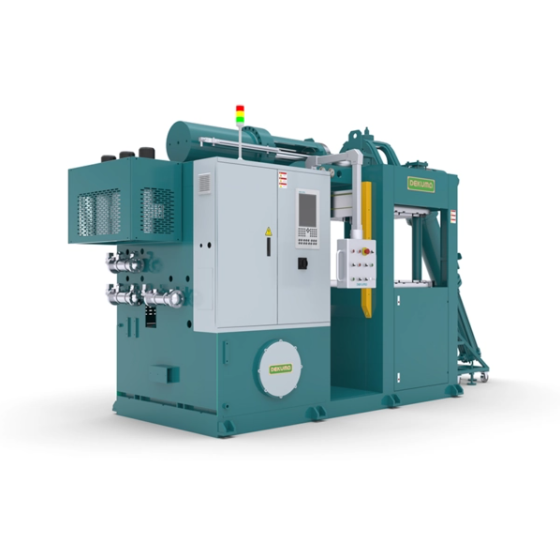
The RA Series Rubber Injection Molding Machine is designed for hollow core insulators, long rod insulators, surge arresters, cable accessories, and switchgear made from silicone rubber or EPDM.
Dekuma positions the series around stable performance and insulator production, supported by industry experience, patents, and certifications. When buyers assess a silicone rubber injection molding manufacturer, these points should be reviewed together with the actual mold, compound, target cycle, and quality requirements rather than as isolated machine claims.
For large or complex parts, thermal stability also depends on the mold. Heating-zone layout, mold mass, cavity geometry, insulation, and contact with heating surfaces can affect how quickly different areas reach the target temperature. Equipment and mold design need to be evaluated as one process system.
Process Development Is Becoming More Data-Driven
Future improvements in insulator molding are likely to come from tighter links between process settings and production evidence. Operators can compare cycle data, defect patterns, cure results, and dimensional checks. These records can support informed adjustments to the molding window.
Data does not replace process knowledge. Teams still need to understand why a parameter changed and what effect it had on the molded part. A silicone rubber injection molding machine also needs suitable mechanical capacity, stable material handling, and a mold that matches the product.
The same principle applies when selecting a silicone rubber injection molding manufacturer. Buyers should discuss part geometry, material, mold layout, curing approach, output target, and inspection method before confirming equipment. This provides a stronger basis for temperature and cure planning than comparing nominal specifications alone.
Dekuma provides turnkey rubber injection molding solutions for customers worldwide. For insulator projects, equipment selection should account for machine configuration, material compatibility, and application requirements. The practical question is how the proposed equipment supports the molding window required by the product.
Where Mold and Cure Control Are Heading
Consistent silicone rubber insulator production depends on suitable mold temperatures, validated curing conditions, repeatable process records, and equipment matched to the mold and compound.
For B2B manufacturers, mold temperature and cure control should therefore be discussed early in equipment planning. When product geometry, material behavior, tooling, and process data are considered together, teams can build a molding method that is easier to adjust, document, and transfer across production batches.
